
The Beautiful Pragmatism of Sean Dyche: My Take on Burnley's Anfield Heist
Look, I'll be brutally honest – I've chuckled at the 'hoofball' memes about Sean Dyche as much as the next football fan. That gravelly voice, the no-nonsense interviews, Burnley seemingly launching the ball into orbit every 30 seconds... it's easy to pigeonhole him as the high priest of anti-football, right? But sitting here in 2025, rewatching his masterclass dissection of Burnley's 1-0 win at Anfield back in January 2021 for The Coaches' Voice, I realize how utterly lazy that stereotype is. It’s the footballing equivalent of judging a book solely by its slightly battered, mud-splattered cover. Yeah, his Burnley played pragmatic, organized, and occasionally… well, let’s just say it wasn't always the footballing equivalent of a symphony. But calling it just long balls? That massively undersells one of the Premier League's shrewdest tactical minds of the last decade. This guy kept the Clarets punching way above their financial weight for SIX years, even dragging them into the dizzying heights of seventh place and Europa League football in 2017/18. Relegation eventually came, sure, but the man orchestrated miracles on a shoestring budget, including that glorious, earth-shattering night at Anfield. And trust me, dissecting how he did it is way more fascinating than any meme.
️ Busting Myths: More Than Just 'Get It In the Mixer'
The lazy narrative paints Dyche as a one-trick pony: win the first header, fight for the second ball, rinse, repeat. Simple. Brutish. Effective? Sometimes. But the reality, especially in that seismic Liverpool victory, was a meticulously crafted tactical plan executed with near-perfect discipline. Dyche himself, in that brilliant analysis, gleefully dismantles the 'hoofball' trope. His strategy wasn't mindless; it was mindful disruption. He wanted to make Anfield feel claustrophobic for a Liverpool side basking in the afterglow of their first Premier League title and riding a frankly ridiculous 68-game unbeaten home league run. How long was that? Only Chelsea's 86-game fortress at the Bridge between 2004-2008 was better! Ending that? With Burnley? It wasn't luck; it was genius under pressure.
️ Squeezing the Life Out of Liverpool: Dyche's Tactical Tweezers
So, how do you beat the nearly unbeatable in their own backyard? Dyche’s masterplan revolved around two core principles:
-
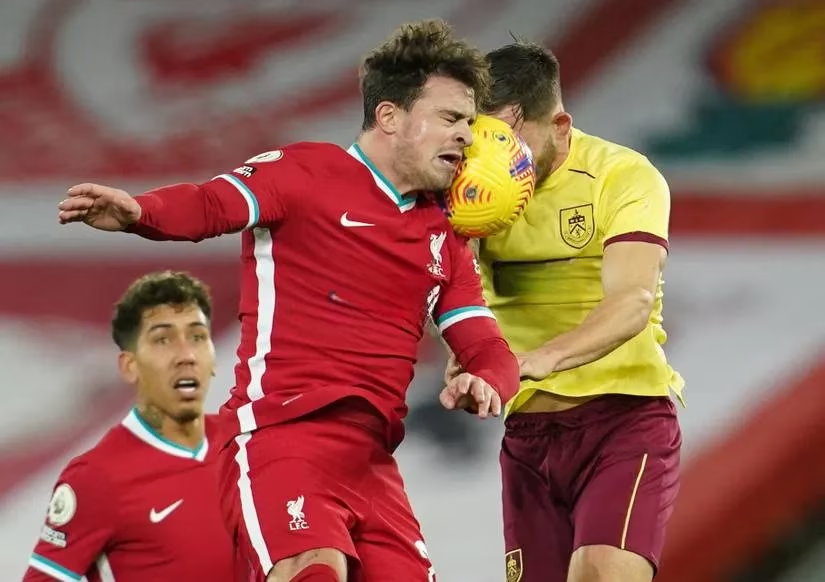
'Crunching' the Pitch: Forget expansive football. Dyche wanted to shrink the playing area, condensing the space Liverpool had to operate in. It was like watching someone slowly squeeze a stress ball. This forced Klopp's slick passers into uncomfortable decisions, often encouraging them to go long themselves, playing right into Burnley’s hands (or more accurately, the towering heads of Tarkowski and Mee). If Liverpool tried to play out from the back? Burnley would aggressively 'lock on' and press them towards one touchline, effectively trapping them and making the space feel tiny. The moment the Reds inevitably switched play with a diagonal ball? WHOOSH! The entire Burnley unit would shift across like a well-drilled regiment, ready to suffocate the space on the other flank before Liverpool could settle. It was defensive choreography at its most effective, and frankly, beautiful in its brutal efficiency.
-
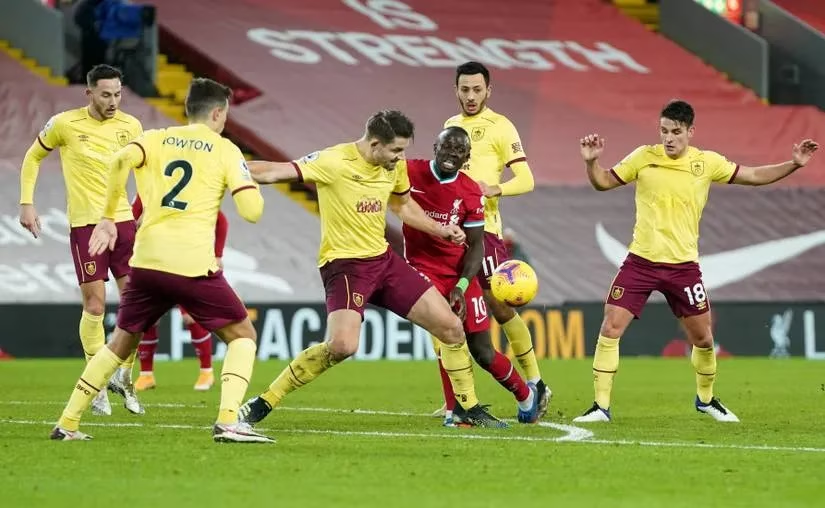
The Impenetrable 'V' & Crossfire Chaos: When Liverpool did breach the midfield (which was rare enough!), Dyche had a specific plan for his back four. They were to stay compact, strictly within the lines of the penalty area, protecting the crucial 'V' zone – that dangerous space fanning out from the goalkeeper. If the ball went wide? Only the relevant full-back would engage. The other three defenders? They stayed put, clogging up the central areas where Liverpool’s deadly finishers lurked. The message was clear: "Go on, whip in a cross. We dare you." Because waiting in the box were Tarkowski and Mee, aerial titans built for that exact scenario. Dyche wanted crosses. He invited them. Why? Because it negated Liverpool's intricate through-balls and played directly to his own defenders' biggest strength. It was a calculated gamble, turning Liverpool's width against them.
The Moment of Magic (Well, Pragmatic Brilliance)
But Dyche didn't just set up to draw. He genuinely believed they could win. Key to this was overcoming Liverpool's infamous 'five-yard fury' – that immediate, intense press the moment they lost possession. Burnley's counter? Embrace the chaos. When Nick Pope collected the ball, he’d often launch it long towards the formidable frame of Chris Wood. Crucially, the players around Wood would instantly converge, 'crunching' that area into a frantic scrap for the second ball. It was ugly, it was physical, it was absolutely effective. The idea? Bypass Liverpool's midfield overload (often 2 vs 3 against Burnley) with direct balls, looking to exploit the space behind Liverpool's high line for Ashley Barnes to chase. And what do you know? That's precisely how Barnes found himself in the right place at the right time to slot home the winner – a goal forged in the fiery pits of Dyche's pragmatic crucible.

Why the 'Long Ball' Label Does Him a Disservice
Watching Dyche break down this game is like attending a masterclass in underdog tactics. Every instruction had purpose. Every player knew their role within an inch of their life. Was it tiki-taka? Absolutely not. Was it effective, intelligent, and perfectly suited to the resources and players at his disposal? One hundred percent. He took a squad assembled for relative pennies, drilled them relentlessly in a system that maximized their strengths (aerial dominance, physicality, discipline) and minimized their weaknesses (lack of creative midfield maestros, limited individual flair), and pulled off results most 'fancier' managers could only dream of. Ending Liverpool's historic home run wasn't a fluke; it was the culmination of years of Dyche refining his pragmatic art. It was proof that 'effective' football, even if it’s not always easy on the eye, deserves immense respect. Frankly, in the ruthless results business of the Premier League, getting points is beautiful, regardless of the brushstrokes used.
So, go ahead, giggle at the Dyche memes. I probably will too sometimes. But deep down, watching that analysis, I just feel immense appreciation. Appreciation for a manager who defied expectations, who squeezed every last drop of potential from his squad, and who proved that tactical intelligence comes in many forms, not just possession-heavy philosophies. He made Burnley matter. He made Turf Moor a fortress. And he masterminded one of the great Premier League giant-killings with a plan so clever, it deserves way more credit than just being called 'long ball'. It makes me wonder, sitting here years later: In the relentless pursuit of points and survival, does the aesthetic 'beauty' of the football truly matter less than the cold, hard, beautiful result it produces? Food for thought, eh?
Leave a Comment
Comments