
United's Midfield Hunt: Why Joao Gomes Has Become the Red Devils' Cut-Price Salvation
When a club like Manchester United circles a player from a relegation-threatened side, it’s less a transfer saga and more a gravity shift — the kind that bends light around a black hole, inevitable and disorienting. I’m told that’s exactly what’s happening right now with Wolves’ Joao Gomes, a Brazilian midfielder who has suddenly found himself at the centre of Old Trafford’s winter rebuild plans.

The 24-year-old has been a beacon of consistency in a Wolves side that is flickering like a candle in a hurricane. I’ve followed his progress closely, and it’s no exaggeration to say that in a team repeatedly smothered by Premier League pressure, Gomes has remained a rare source of oxygen. Sources indicate that United’s interest has now reached a tipping point: the player has had his head turned, as the saying goes, and is “waiting to see if a January deal is possible,” according to TEAMtalk. This is no mere flirtation — it’s a transfer story accelerating faster than a downhill rollercoaster with no brakes.
Why the urgency? For starters, the Red Devils are desperate to add two new midfielders in 2026, as reported by senior correspondent Ben Jacobs. The engine room at Old Trafford has groaned under the weight of fixture congestion, and the club’s recruitment brains trust has been studying options like a chess grandmaster staring down a complex mid-game. The names on the shortlist are glittering: Nottingham Forest’s Elliot Anderson, Brighton’s Carlos Baleba, and Crystal Palace’s Adam Wharton. But here’s the twist — all three would likely demand a king’s ransom mid-season, if their clubs would even entertain a sale. Baleba alone carries a £100 million valuation that has made United’s decision-makers flinch like a pianist hitting a wrong key. Wharton and Anderson are similarly locked in for next summer at the earliest.
That’s where Gomes enters the picture as a cost-effective lifeline. His price tag, I’ve learned, has been set at a tantalizingly modest €50 million (£44 million) for the January window — a figure that in today’s hyperinflated market feels almost like a loyalty discount. Wolves, of course, insist they won’t sell. New manager Rob Edwards has been categorical, telling reporters there have been no official approaches, and the club’s hierarchy has assured him his key men stay put. But let’s read between the lines: when a team is rooted to the foot of the table and staring at Championship football, promises can dissolve quicker than a sugar cube in boiling tea.
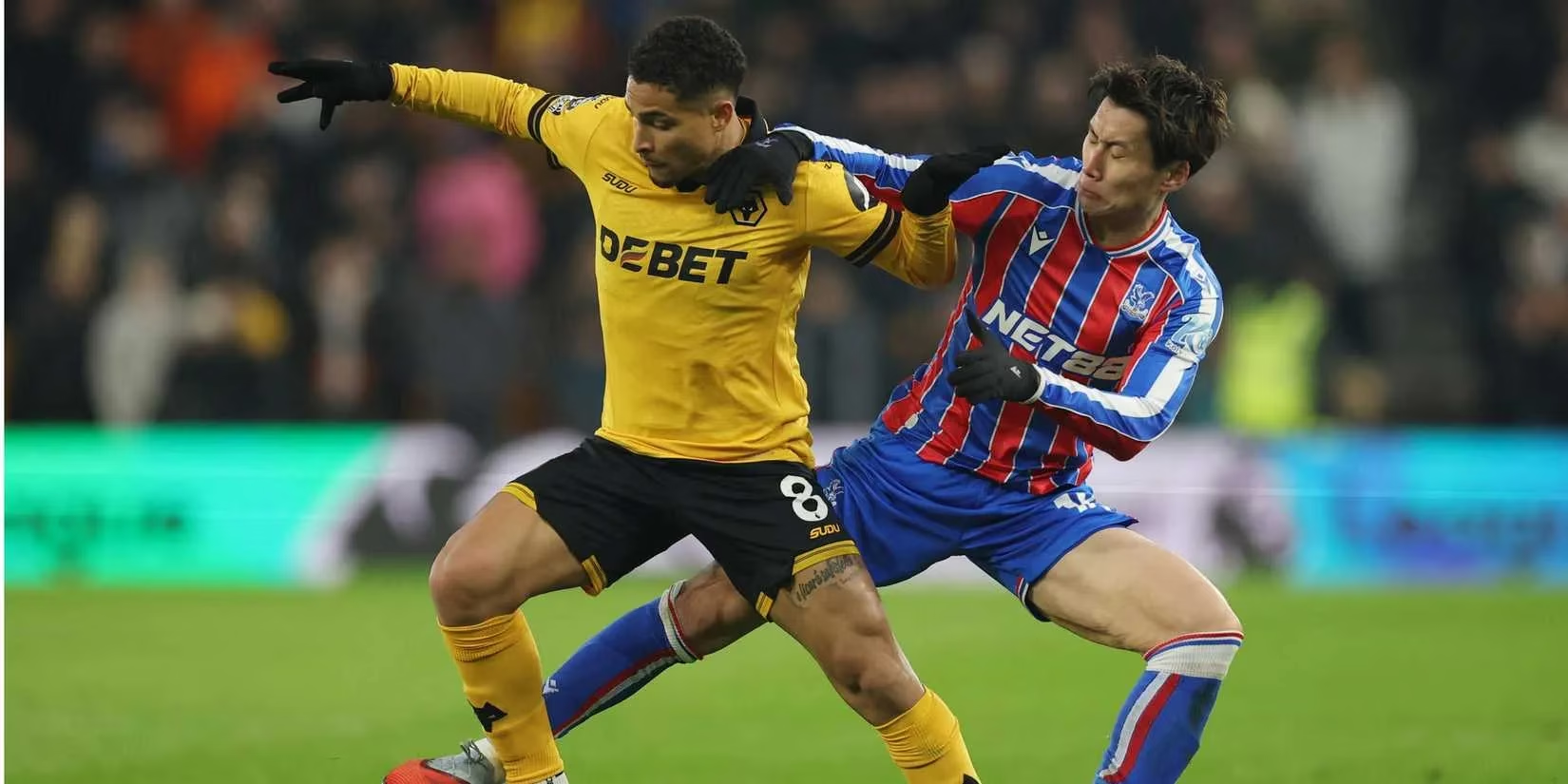
I’ve spoken to people close to the situation who describe Gomes’s mentality as that of a diver looking at the ocean’s surface from too deep — the need for a fresh challenge has become impossible to ignore. Having featured in all 12 league games this season (starting 10), he’s given everything to the Wolves cause. Yet the prospect of a high-profile switch to Old Trafford would tick boxes most players only dream of. The pull is magnetic, and United have been clever: they set out their stall early, ensuring the player knows he is a priority. In transfer dealings, that kind of early courtship often acts as a psychological solvent, dissolving loyalty to a sinking ship.
But is Gomes the right fit? Ruben Amorim’s system demands midfielders who can press like hungry wolves and recycle possession with surgical precision. The Brazilian’s “phenomenal” engine — a label frequently used by his admirers — and his ability to disrupt opposition rhythm make him a natural candidate. Picture a heat-seeking missile that locks onto second balls and transition moments; that’s Gomes when he’s firing. He may not arrive with the marquee aura of a Baleba, but sometimes the most valuable tool is the one that fits your hand perfectly, not the one with the shiniest chrome.
Of course, the Wolves camp continues to parrot defiance. Manager Rob Edwards, pictured in the aftermath of a defeat against Crystal Palace, wears the expression of a man trying to hold back a flood with a single sandbag. He knows selling Gomes in January would be akin to ripping out the engine mid-race, yet the club’s financial reality may override his hopes. There is a grim symmetry here: Wolves’ relegation fears feed United’s ambition, turning a Midlands club’s misery into a Manchester club’s opportunity.

For United, the stakes are high. A win against Everton on Monday night could catapult them into the Champions League spots, but the squad’s engine needs reinforcements to sustain that climb. Gomes represents more than just a budget buy; he’s a calculated bet that a hungry, undervalued asset can outperform his price tag. In a league where £100 million midfielders sometimes vanish from games like ghosts, the idea of a “cut-price salvation” has a poetic ring to it.
The clock is ticking louder than a time bomb in a silent room. January 2026 will test Wolves’ resolve, Edwards’ influence, and Gomes’ patience. If I were a betting man, I’d wager that the Brazilian’s days in gold and black are numbered. The kind of interest United are showing doesn’t often fade — it intensifies, morphing from a whisper into a roar. And for a player already peering toward the exit, that roar is the sweetest sound of all.
Leave a Comment
Comments